Lure Match: Why the Right Lure and Retrieve Catch More Fish
Most anglers have had the same frustrating session. You know fish are there. The tide looks good. The spot looks right. You might even see bait, boils, follows or fish on the sounder. But no matter how many casts you make, nothing commits. Often, the problem is not the location. It is the match.
The lure is too big, too small, too heavy, too fast, too subtle, too aggressive, too high in the water, too low in the water, or moving in a way that does not suit the fish’s mood.
That is why lure choice and retrieve style matter so much.
Catching fish on lures is not just about throwing something that looks like food. It is about putting the right profile, at the right depth, moving at the right speed, in front of the right species, at the right time.
That is where the idea of Lure Match comes in.
What Lure Match Really Means
Lure Match is the process of choosing a lure and retrieve that suits the exact fishing situation in front of you.
It is not just asking:
What lure should I use?
It is asking:
What are the fish eating, where are they sitting, how active are they, and how do I make this lure look like an easy target?
A good lure match considers:
- TextTarget species
- Water depth
- Tide movement
- Current speed
- Water clarity
- Wind
- Light level
- Structure
- Bait size
- Fish activity level
- Bottom type
- Retrieve style
- Hook size and weight
- Scent, sound, vibration and profile
That sounds like a lot, but on the water it becomes simple.
If fish are feeding aggressively, you can move faster and use more vibration or flash.
If fish are cautious, pressured or inactive, you usually need to slow down, downsize, fish lighter and make the lure look easier to eat.
Why the Correct Lure Makes Such a Difference
Fish make fast decisions
When a lure moves past them, they are judging it by shape, size, speed, vibration, depth, colour, scent and behaviour. If one or two of those things feel wrong, the fish may follow, swipe, bump or ignore it completely.
The correct lure does three important things.
- First, it reaches the fish. A perfect lure fished above or below the strike zone is not perfect anymore.
- Second, it looks believable. The size, action and profile should suit what the fish are expecting to eat.
- Third, it triggers a response. Sometimes that response is hunger. Sometimes it is aggression. Sometimes it is instinct. Sometimes it is simply the fish deciding the lure is too easy to pass up.
That is why two anglers can fish side by side and get completely different results. One is just casting. The other is matching the lure to the situation.
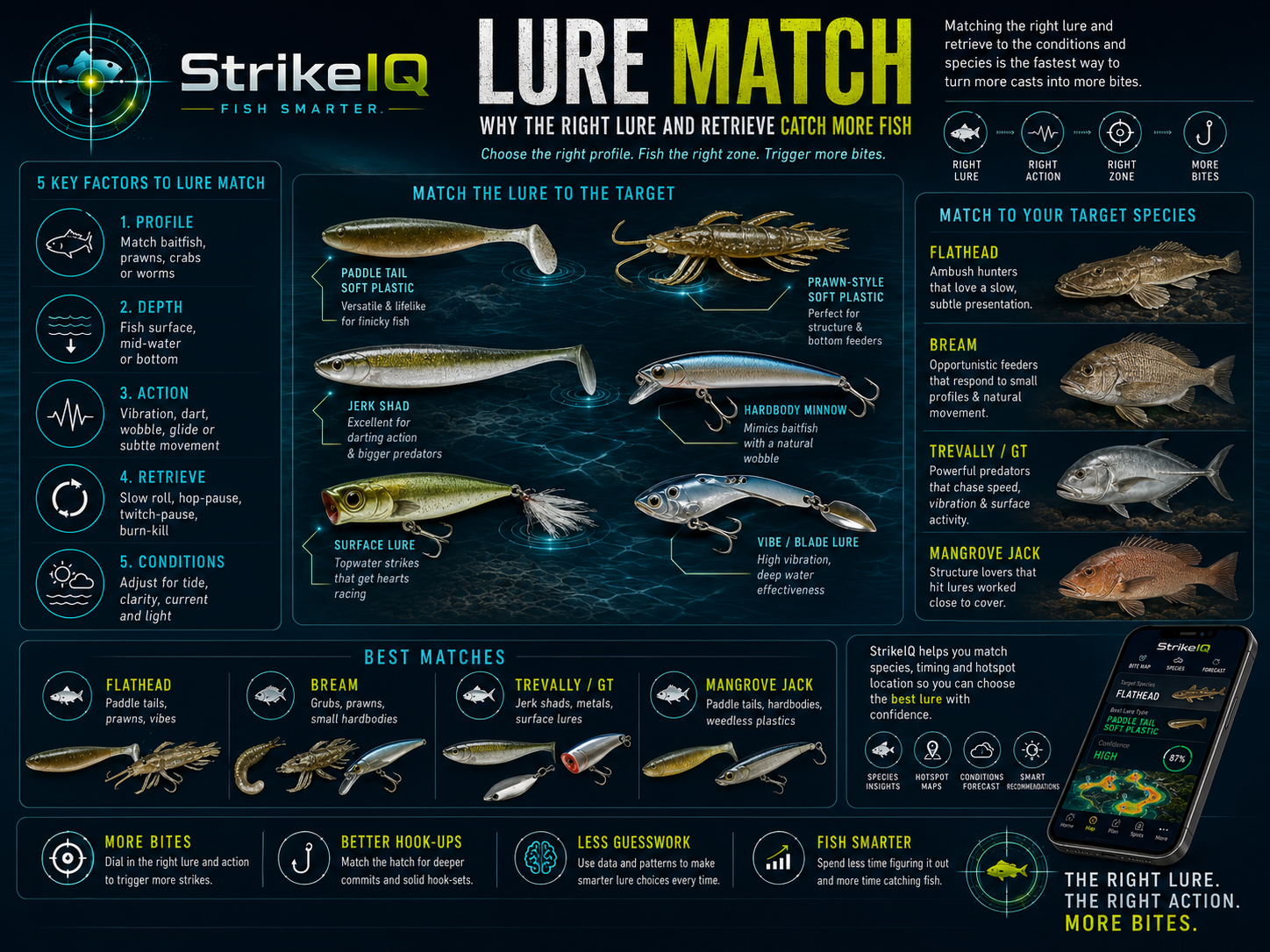
Profile: What the Lure Looks Like
The first part of lure match is profile.
- A paddle tail looks like a swimming baitfish.
- A prawn plastic looks like a prawn or shrimp moving naturally through structure.
- A grub or curl tail gives subtle movement at slow speed.
- A jerk shad looks like a wounded baitfish.
- A crab, yabby or creature bait looks like bottom food.
- A vibe creates strong vibration and is excellent for deeper water or dirty conditions.
- A surface lure imitates fleeing bait, prawns, insects or nervous prey on top.
No single profile is best all the time.
- A flathead sitting on a drain edge may want a paddle tail or prawn hopped along the bottom.
- A bream under a pontoon may respond better to a small grub or lightly weighted prawn.
- A GT hunting bait near a bridge may want a fast-moving jerk shad, paddle tail, metal or surface lure.
- A mulloway in a deeper hole may need a larger plastic or vibe that stays close to the bottom.
The profile needs to suit the species and the feeding situation.
Size: Matching the Meal
Lure size is one of the easiest things to get wrong.
Many anglers fish too big when fish are cautious and too small when predators are feeding on larger bait.
A lure that is too big can spook pressured fish or look unnatural. A lure that is too small may not get noticed, especially in dirty water, deep water or fast current.
As a simple guide:
- Small lures work well for bream, whiting, finicky flathead, pressured fish and clear water.
- Medium lures are the best all-round choice for canals and estuaries. They suit flathead, bream, trevally, tarpon and general searching.
- Larger lures suit mangrove jack, GT, tailor, mulloway, snapper and bigger flathead.
A 2.5 to 3.5 inch soft plastic is one of the best starting points for canal fishing because it is big enough to attract predators but not so big that smaller estuary species ignore it.
Weight: Getting Into the Strike Zone
Weight is often more important than colour.
A lure must spend time where the fish are feeding. Too light and it never reaches the zone. Too heavy and it falls unnaturally, snags too often, kills action or races past fish too quickly.
For soft plastics, the jighead weight controls the sink rate, bottom contact and action.
For hardbodies, bib size and buoyancy control depth.
For vibes and metals, weight controls casting distance, sink speed and how quickly the lure can be worked.
The best rule is:
- Use the lightest weight that still lets you reach the target zone and stay in contact with the lure.
- For shallow canal edges, light jigheads create a natural fall.
- For drains and sand edges, a moderate jighead helps keep contact with the bottom.
- For bridge pylons, deep holes and strong current, heavier presentations may be needed.
- For surface feeding fish, weight matters less than keeping the lure in the feeding lane and moving naturally.
When in doubt, watch the sink. If the lure drops like a rock, go lighter. If you cannot feel it or it never reaches the fish, go heavier.
Colour: Important, But Not Everything
Colour matters, but it is usually not the first problem.
Depth, speed, profile and retrieve normally matter more. Still, colour can make a big difference once the other parts are right. In clear water, natural colours are usually best. Think baitfish silver, pearl, olive, motor oil, bloodworm, natural prawn and translucent colours. In dirty water, stronger colours and contrast help fish find the lure. White, chartreuse, pink, gold, black, dark purple and UV colours can all work. In low light or night conditions, dark silhouettes often stand out better than many anglers expect.
When prawns, yabbies or shrimp are active, brown, amber, bloodworm and natural prawn colours can be excellent.
The key is not to carry fifty colours. Carry a few natural colours, a few dirty-water colours and a few low-light options. Then focus on putting the lure in the right place.
Retrieve Style: The Other Half of Lure Match
The retrieve is just as important as the lure.
A good lure worked badly will often get ignored. An average lure worked perfectly can catch plenty of fish. The retrieve tells the fish what the lure is. Is it fleeing? Injured? Feeding? Crawling? Dying? Drifting? Panicking? Different species respond to different movements.
Slow Roll
A slow roll is a steady retrieve through the target zone.
It works well with paddle tails, small hardbodies, spinnerbaits, vibes and swimbaits.
Use it when fish are actively looking for baitfish or when you need to cover water.
Best for: flathead, trevally, tailor, mulloway, snapper and searching canal edges.
Hop-Hop-Pause
This is one of the best retrieves for soft plastics.
Let the lure hit bottom, lift the rod tip once or twice, then let it fall again.
Many bites come on the drop or pause.
Best for:flathead, bream, snapper and fish feeding close to bottom.
Drag and Pause
Move the lure slowly along the bottom with small rod sweeps.
This makes the lure look like a prawn, worm, crab, yabby or injured bait sitting close to the bottom.
Best for: bream, whiting, flathead and tough bites.
Burn and Kill
Wind quickly, then suddenly stop.
The lure looks like fleeing bait that suddenly stalls. Predators often hit on the pause.
Best for: trevally, GT, tailor, queenfish, tarpon and fast-moving fish.
Twitch-Twitch-Pause
Use short rod twitches to make a lure dart side to side, then pause.
This is excellent with jerk shads, minnows and suspending hardbodies.
Best for: trevally, tarpon, giant herring, mangrove jack, tailor and baitfish feeders.
Dead-Stick
Cast the lure and barely move it.
This can be deadly when fish are pressured, cold, cautious or feeding slowly.
Best for: bream, finicky flathead, clear water and slack tide.
Surface Walk or Pop
Surface lures work by creating commotion, panic and silhouette.
Some should walk side to side. Others should bloop, spit or pause.
The pause is often the trigger.
Best for: whiting, bream, trevally, GT, tailor, jacks and low-light canal predators.
Matching Lures to Species
Flathead
Flathead are ambush feeders. They sit close to the bottom and wait for food to come past.
The key is keeping the lure near the bottom without constantly snagging.
Best lures: paddle tails, prawns, curl tails, vibes, shallow hardbodies and jerk shads.
Best retrieves: hop-hop-pause, slow roll near bottom, lift-drop and drag-pause.
Best zones: drains, sand edges, channel lips, drop-offs, flat edges and creek mouths.
A good flathead lure match is usually a soft plastic or vibe that stays in the strike zone long enough for the fish to ambush it.
Bream
Bream can be aggressive, but in canals and pressured areas they are often cautious.
They like structure, shade, current and small natural food.
Best lures: small grubs, prawns, creature baits, crankbaits, small vibes and surface lures.
Best retrieves: slow roll, tiny hops, pause, dead-stick and slow twitch.
Best zones: pontoons, rock walls, bridges, drains, mangroves, moored boats and shaded edges.
For bream, lighter is often better. A slow, natural fall can be the difference between a follow and a bite.
Whiting
Whiting respond well to small, subtle lures over clean sand and shallow flats.
They often like movement, but not always too much bulk.
Best lures: worm plastics, small grubs, tiny prawns, small surface lures and shallow crankbaits.
Best retrieves: slow drag, tiny hops, constant surface walk and long pauses.
Best zones: sand flats, yabby banks, shallow gutters and clean canal edges.
For whiting, lure size and subtlety matter. If they are following but not eating, go smaller or change the retrieve speed.
Trevally and GT
Trevally and GT are reaction predators. They often respond to speed, bait movement and current.
The lure usually needs to look alive, fleeing or injured.
Best lures: paddle tails, jerk shads, metals, vibes, stickbaits, poppers and minnows.
Best retrieves: fast roll, burn-and-kill, twitch-twitch-pause and surface work.
Best zones: canal mouths, bridge lights, current seams, bait schools, deeper edges and rock walls.
For trevally, do not be afraid to retrieve faster. Many anglers fish too slowly when the fish are chasing bait.
Mangrove Jack
Mangrove jack are structure predators. The lure needs to get close to cover, and the retrieve needs to trigger a fast reaction.
Best lures: paddle tails, prawns, hardbodies, swimbaits, weedless plastics and surface lures.
Best retrieves: tight cast, sink, slow roll, twitch, pause, then hold on.
Best zones: pontoons, rock walls, bridges, mangroves, pylons, jetties and shaded edges.
For jacks, accuracy matters. A lure one metre away from structure may be ignored. A lure tight to the edge can get smashed.
Mulloway
Mulloway often respond to depth, tide movement, bait and low light.
The key is keeping the lure in the zone long enough.
Best lures: larger paddle tails, jerk shads, vibes, squid profiles and swimbaits.
Best retrieves: slow roll near bottom, lift-drop, long pause and controlled hop.
Best zones: deep holes, bridges, channel edges, river mouths, canal confluences and bait schools.
For mulloway, depth control is everything. A lure moving above the fish may never be seen.
Tailor
Tailor are aggressive baitfish hunters.
They often respond to flash, speed and erratic movement.
Best lures: metals, minnows, stickbaits, paddle tails and surface lures.
Best retrieves: fast roll, burn-and-kill, twitching and surface commotion.
Best zones: bait schools, beaches, canal mouths, current lines and bridge lights.
For tailor, speed is often your friend. If they are active, make the lure look like fleeing bait.
Matching Lures to Conditions Clear Water
Use natural colours, smaller profiles, lighter weights and more realistic retrieves.
Fish can see better, so they are more likely to reject something that looks wrong.
Dirty Water
Use stronger vibration, contrast, scent and slower retrieves.
Fish may need more help finding the lure.
Paddle tails, vibes, curl tails, rattling hardbodies and scented plastics can all help.
Strong Current
Use enough weight to stay in the zone.
Cast up-current and let the lure move naturally with the flow.
Predators often sit on current edges waiting for food to come past.
Slack Water
Slow down.
Fish often become less aggressive when the water stops moving. Try smaller plastics, subtle hardbodies, scent, long pauses and lighter presentations.
Low Light
Use silhouettes, vibration, surface disturbance and structure.
Dawn, dusk, night and heavy cloud can make fish more confident, especially around bridges, pontoons, rock walls and drains.
#### How StrikeIQ Helps With Lure Match
StrikeIQ helps anglers make better lure decisions by narrowing down the fishing situation before they even tie on a lure.
Instead of guessing, the angler can look at the target species, Bite Map area, time window and conditions, then choose a lure that matches the opportunity.
If StrikeIQ points to a flathead bite around drains and sand edges, the lure choice becomes clearer: a soft plastic, prawn, paddle tail or vibe worked near bottom.
If the app highlights trevally around current lines or bridges, the angler can choose a faster baitfish profile, metal, jerk shad, paddle tail or surface lure.
If bream are favoured around structure, the angler can go smaller, lighter and slower.
If the bite window is strong, the angler can cover water and fish more confidently.
If the bite window is weak or fading, the angler can slow down, downsize, add scent and focus on high-percentage structure.
That is the value of Lure Match.
It connects the forecast to the actual lure you throw.
Common Lure Fishing Mistakes
Choosing Colour First
Colour matters, but it should not be the first decision.
Choose depth, profile, size and retrieve first. Then fine-tune colour.
Fishing Too Heavy
Heavy lures are easier to feel, but they often look unnatural.
A lighter lure can stay in the strike zone longer and fall more naturally.
Fishing Too Fast
Many fish eat on the pause.
If you are getting follows, taps or bumps, slow down and add longer pauses.
Fishing Too Slow
The opposite can also be true.
Trevally, tailor, GT and other predators often want speed. If they are chasing bait, a slow lure can look wrong.
Ignoring the Water Column
Flathead may be on the bottom. Trevally may be mid-water. Tailor may be high. Bream may be suspended under a pontoon.
Fish the level where the fish are feeding.
Not Changing Retrieve
Many anglers change lure colour before changing retrieve.
Often, the retrieve is the problem.
Try faster, slower, sharper, softer, longer pauses or a different angle before giving up.
Not Matching the Hook or Jighead
A soft plastic rigged on the wrong hook will not swim properly.
The lure should sit straight, move freely and match the weight needed for the depth and current.
A Simple Lure Match System
Before your next cast, ask five questions.
- What species am I targeting? This decides the lure profile and retrieve style.
- Where are the fish likely sitting? Bottom, mid-water, surface, structure, edge, current line or flat.
- How active are they? Aggressive fish can be triggered. Cautious fish need a slower, more natural presentation.
- What is the water doing? Current, clarity, wind, tide and light all change lure choice.
- What does my lure need to imitate? Baitfish, prawn, crab, worm, squid, fleeing prey or injured food.
Answer those questions and lure choice becomes much easier.
Practical Examples
Canal Drain for Flathead
Use a 3 inch paddle tail or prawn plastic on a jighead heavy enough to touch bottom.
Cast across or slightly up-current.
Let it sink, hop it along the drain edge, then pause.
Most bites will come as the lure drops or sits near bottom.
Bridge Light for Trevally
Use a small jerk shad, paddle tail, metal or surface lure.
Cast past the light line and bring the lure through the edge of the shadow.
Use a fast retrieve with sudden pauses.
Trevally often hit when the lure changes speed.
Pontoon Line for Bream
Use a small grub, prawn or creature bait on a light jighead.
Cast tight to the pontoon or shade.
Let the lure sink naturally and watch the line.
Use tiny hops, slow drags and pauses.
Rock Wall for Mangrove Jack
Use a strong paddle tail, hardbody or weedless plastic.
Cast tight to the wall or structure.
Let it sink slightly, then slow roll with twitches and pauses.
Be ready immediately. The bite usually comes fast.
Deep Hole for Mulloway
Use a larger paddle tail, vibe or jerk shad.
Get the lure close to bottom.
Use a slow roll, lift-drop or long pause retrieve.
Stay patient. The lure must spend time in the zone.
Final Cast
Catching fish on lures is not about owning the most lures.
It is about choosing the right lure for the right job.
The correct lure profile gets attention. The right size looks believable. The right weight keeps it in the strike zone. The right colour helps fish see it. The right retrieve makes it look alive.
When those things line up, your chances improve dramatically.
That is what Lure Match is all about.
StrikeIQ helps narrow down the species, timing and likely zone. Lure Match helps you choose how to fish it.
Together, they turn random casting into a plan.
Fish the right lure, in the right zone, the right way.
That is how you turn follows into bites, taps into hook-ups, and good-looking water into landed fish.