
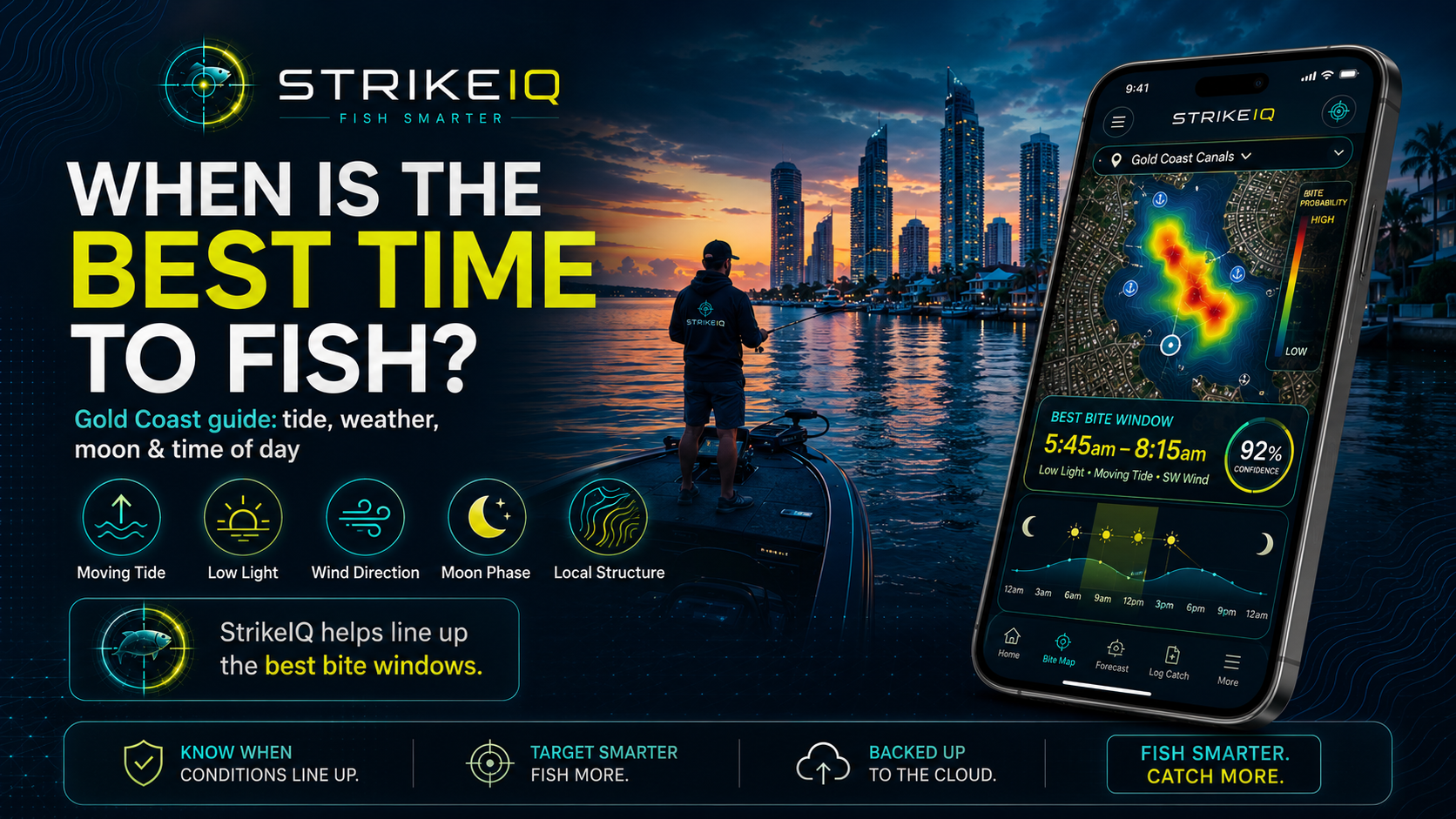
When Is the Best Time to Fish on the Gold Coast?
Most anglers know the feeling. You finally get a few spare hours, grab the gear, get to the water… and nothing happens.
The truth is, fishing is rarely just about one thing. It is not only the tide, or only the moon, or only the weather. The best sessions usually happen when a few things line up at the same time.
On the Gold Coast, that means looking at tide, wind, time of day, moon phase, pressure, water movement and the type of spot you are fishing. That is exactly why StrikeIQ was built.
Start with moving water
If you remember one thing, remember this: Fish moving water more than dead water. Around the Gold Coast canals, Broadwater, creeks and estuaries, tide movement pushes bait around. When bait moves, fish usually become more active. The best window is often not right on high tide or low tide. It is usually during the run, especially when water is pushing over flats, draining off banks, moving past bridge pylons, or pulling out of canals and drains.
For flathead, the run-out tide can be excellent because bait gets pushed off shallow flats and into channels. For bream, moving water around pontoons, rock walls and bridge structure can switch them on. For whiting, clean water moving across sand flats is often a good sign.
Low light helps
Early morning and late afternoon are simple, reliable times to look at. Fish are often more confident in low light. Bait is active, glare is lower, boat traffic is quieter, and predators can feed more comfortably. If first light or last light lines up with a good tide movement, that is when you should be paying attention.
A sunrise high tide with water starting to run out can be good. So can a late afternoon incoming tide pushing bait back over flats and edges.
Wind matters more than people think
Wind can make or break a session. A light breeze can help. It puts ripple on the water, breaks up visibility, moves bait, and can push food into wind-blown banks. But strong wind can ruin a plan fast. If the beach is messy or the Broadwater is chopped up, the better option might be a protected canal, creek mouth, bridge, marina edge or leeward bank.
This is where local knowledge matters. A spot that is terrible in one wind direction might be perfect in another.
Moon phase is useful, but not magic
A lot of anglers talk about the moon. It does matter, but it is not a magic switch. The main thing the moon changes is tidal strength. Around new moon and full moon, the tide usually has more push. That can fire up current lines, drains, channel edges and bait movement.
On smaller tides, fish can still bite, but you may need to focus more on structure, shade, depth changes and low-light periods. Do not fish only because the moon looks good. Fish because the moon, tide, weather and spot all work together.
Pressure and weather changes
Barometric pressure can affect fishing, but it is best treated as one more clue. A stable or slowly changing system is usually easier to fish than wild, unsettled weather. Before a change, some fish can feed harder. After a big blow, heavy rain or dirty water, some areas can shut down while others fire up.
On the Gold Coast, rain can be good or bad depending on where you fish. A little runoff can push food and bait out of drains. Too much freshwater can make some canal and creek areas dirty or low in salinity. That is why the same weather can help one spot and hurt another.
Match the time to the species
The best time also depends on what you are chasing. Flathead often respond well to draining water, channel edges, sand banks and bait being pushed off flats. Bream are good around structure, especially when tide pushes food past pontoons, pylons, rock walls and mangroves.
Whiting like clean water over sand flats and shallow edges. Mangrove jack are more likely to fire in low light, around heavy structure, warm water and strong ambush points. Mulloway are a better low-light or night target around deeper water, bridges, current lines and bait. This is where a general tide chart only gets you so far. The “best time” for flathead on a sand drain is not always the best time for jack in a canal pontoon line.
How StrikeIQ helps
You can learn all of this yourself, but the hard part is lining it all up quickly. StrikeIQ looks at the things anglers already care about:
- tide movement
- weather
- wind
- moon phase
- pressure
- time of day
- local structure
- species behaviour
- recent trip and catch data
Then it helps answer the real question: Where should I fish, what should I target, and why now?
The Bite Map highlights likely areas. Target species briefings explain what is working and why. Trip Log and Insights help you build your own pattern over time.
It is not a guarantee. Fishing never is. But it gives you a much better starting point than guessing.
The simple answer
The best time to fish on the Gold Coast is usually when: moving tide + low light + fishable weather + the right structure + the right species all line up. That might be a run-out tide for flathead in a canal. It might be a late afternoon incoming tide for whiting on a flat. It might be a night tide around bridge lights for mulloway.
Check the conditions, pick the right window, and use StrikeIQ to narrow it down before you leave home.