
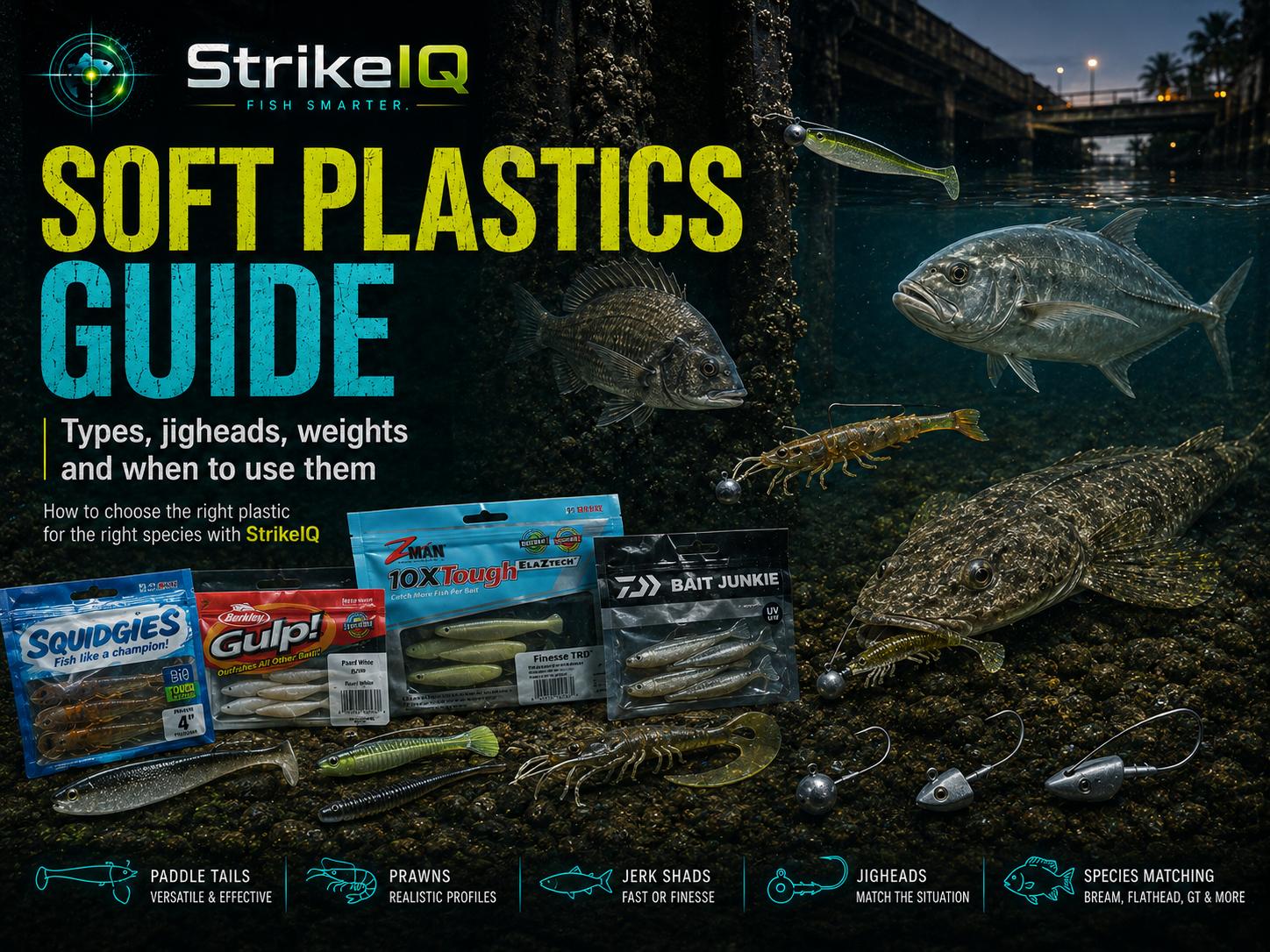
Soft Plastics Fishing Guide: Types, Jigheads, Weights and Species
Soft plastics are one of the most versatile lure styles an angler can use. They can imitate baitfish, prawns, worms, crabs and injured prey, and they can be fished shallow, deep, fast, slow, around structure or along the bottom.
For canal and estuary anglers, soft plastics are especially useful because they let you target multiple species with one tackle tray. A small grub might catch bream under a pontoon. A paddle tail can cover water for flathead. A jerk shad can trigger trevally or GT around current. A prawn plastic can be deadly around drains, bridge pylons and canal lights.
The key is choosing the right plastic, jighead, weight and retrieve for the species and situation.
That is where StrikeIQ helps. Before you start casting, use the app to check the likely bite window, target species and Bite Map hotspots. Once you know where the fish are more likely to be, you can choose the soft plastic setup that matches the zone.
Start With a Plan
Before tying on a lure, ask three questions.
What species is are you targeting?
Flathead, bream, whiting, mangrove jack, trevally, GT and mulloway all feed differently. Your target species should guide your plastic choice.
What type of location is it?
A drain, pontoon, bridge pylon, rock wall and channel edge all need different lure presentations.
What stage is the bite window in?
If the bite is building, cover water. If it is peaking, fish high-confidence structure. If it is fading, slow down, downsize and add scent.
The Main Types of Soft Plastics
Paddle Tails
Paddle tails are the best all-round soft plastic. Their tail kicks on the drop and during the retrieve, making them easy for fish to find.
Best for: flathead, trevally, GT, mangrove jack, tailor, mulloway and snapper.
Where to use them: drains, sand edges, canal mouths, bridge pylons, rock walls, weed edges and bait schools.
Best retrieves: slow roll, hop-hop-pause, lift-and-drop, or burn-and-kill for trevally.
A 2.5 to 3 inch paddle tail is a great canal starting point. It is small enough for bream and trevally but still big enough for flathead. Step up to 3.5 to 5 inches for bigger flathead, GT, jacks and mulloway.
Curl Tails and Grubs
Curl tails work well at slow speeds. The tail moves even when the lure is barely moving, which makes them useful when fish are cautious.
Best for: bream, flathead, whiting and pressured fish.
Where to use them: pontoons, rock walls, sand flats, drains and bridge shade.
Best retrieves: tiny hops, slow lifts, bottom drag and long pauses.
Use curl tails when fish are tapping the lure but not committing, or when clear water calls for a more subtle presentation.
Jerk Shads and Baitfish Profiles
Jerk shads look like small injured baitfish. They do not have much built-in action, so the angler creates movement with rod twitches.
Best for: trevally, GT, tailor, giant herring, tarpon, mulloway and mangrove jack.
Where to use them: current lines, bridge lights, canal intersections, bait schools and deeper structure.
Best retrieves: twitch-twitch-pause, burn-and-kill, sharp lifts and mid-water pauses.
If StrikeIQ points you to trevally or GT around a canal mouth, bridge or current seam, a jerk shad is a strong choice.
Prawn and Shrimp Plastics
Prawn profiles are excellent in estuaries and canals because prawns are natural prey for many species.
Best for: flathead, bream, mangrove jack, whiting, trevally and mulloway.
Where to use them: drains, pontoons, bridge pylons, rock walls, canal lights and current breaks.
Best retrieves: short hops, sink-pause, slow drag and skip-casts into shade.
Prawn plastics are especially useful on run-out tides, after rain, around drains and at night near lights.
Creature Baits, Crabs and Yabbies
Creature baits imitate bottom prey. They are less about fast action and more about looking like something easy to eat.
Best for: bream, flathead, whiting and snapper.
Where to use them: rock walls, rubble, sand holes, oysters, weed patches and pontoon shade.
Best retrieves: drag-pause, small hops, shake in place and dead-stick.
Use creature baits when fish are pressured, feeding close to bottom, or ignoring faster-moving lures.
Worm Plastics
Worm plastics are subtle and natural. They work best on light gear in shallow water.
Best for: whiting, bream and finicky flathead.
Where to use them: shallow sand flats, yabby banks, clean canal edges and gutters.
Best retrieves: slow drag, tiny hops and long pauses.
If you can see fish moving over shallow sand but they are refusing bigger lures, a worm plastic can save the session.
Soft Vibes and Hybrid Soft Lures
Soft vibes are not traditional jighead-rigged plastics, but they are useful when fish are deep or when you need vibration.
Best for: flathead, mulloway, trevally, bream and snapper.
Where to use them: deep holes, bridges, channel edges and strong current.
Best retrieves: lift-vibrate-drop, slow hops and vertical work.
Use a soft vibe when wind, depth or current makes it hard to keep a normal plastic in the strike zone.
Choosing the Right Plastic Size
- 1.5-2 inches Finesse and tough bites Bream, whiting, small flathead
- 2-2.5 inches Light canal fishing Bream, whiting, flathead, trevally
- 2.5-3 inches General canal use Flathead, bream, trevally, tarpon
- 3-4 inches Bigger baitfish profile Flathead, GT, jack, tailor, mulloway
- 4-5 inches Bigger predators Jack, GT, mulloway, snapper
- 5-7 inches Deep water and big fish Mulloway, snapper, big flathead
For most canal sessions, start with a 2.5 to 3.5 inch plastic. Go smaller for pressured bream and whiting. Go bigger when chasing jacks, GT, mulloway or larger flathead.
Jighead Weight: The Most Important Choice
Jighead weight controls how fast your lure sinks, how naturally it moves and whether it reaches the fish.
The best rule is:
Use the lightest jighead that still lets you reach the target zone and stay in touch with the lure. Too heavy and the plastic falls unnaturally, snags more and loses action. Too light and it never reaches the fish.
Starting weight;
- Shallow flats under 1 m - 1/40-1/20 oz
- Canal edges 1-2 m - 1/20-1/12 oz
- Sand edges and drains 1-3 m - 1/12-1/8 oz
- Moderate current or 2-4 m - 1/8-1/6 oz
- Bridge pylons and deeper canals - 1/6-1/4 oz
- Deep holes, fast run-out or wind - 1/4-3/8 oz
These are starting points. If the lure is smashing bottom, go lighter. If you cannot feel it or it is drifting above the fish, go heavier.
Hook Size Guide
Plastic size / Common hook size
- 1.5-2 inches #6 to #2
- 2-2.5 inches #2 to #1/0
- 2.5-3 inches #1 to 2/0
- 3-3.5 inches 1/0 to 3/0
- 3.5-4 inches 2/0 to 4/0
- 4-5 inches 3/0 to 5/0
- 5-7 inches 5/0 to 8/0+
The hook should exit the plastic cleanly and sit straight. If the plastic is bent, twisted or bunched up, it will swim poorly.
Jighead Types and When to Use Them
Standard Round Jighead
The most versatile jighead. Use it for general canal and estuary fishing.
Best for: paddle tails, grubs, prawns and small minnows.
Species: flathead, bream, whiting, trevally and snapper.
Minnow or Fish-Head Jighead
These give the lure a more natural baitfish profile.
Best for: paddle tails, jerk shads and baitfish plastics.
Species: trevally, GT, tailor, jack, mulloway and flathead.
Dart Jighead
A dart head gives jerk shads more side-to-side movement.
Best for: slim minnows and jerk shads.
Species: trevally, GT, tarpon, giant herring and tailor.
Weedless Jighead or EWG Hook
Weedless hooks hide the hook point and help the lure come through cover.
Best for: pontoons, weed, mangroves, oysters, rock walls and snag-heavy canals.
Species: mangrove jack, bream, flathead and trevally around structure.
Weedless rigs snag less, but exposed hooks usually hook fish better. Use weedless when the structure demands it.
Belly-Weighted Swimbait Hook
This lets a plastic swim more horizontally and fall naturally.
Best for: paddle tails, swimbaits and weedless presentations.
Species: mangrove jack, flathead, trevally, GT and mulloway.
Heavy-Duty Jighead
Use heavy-duty hooks when powerful fish can reef you.
Best for: jacks, GT, big trevally, mulloway and snapper.
Where: bridge pylons, pontoons, rock walls and heavy current.
Matching Plastics to Species
Flathead
Flathead sit near the bottom and ambush prey.
Best plastics: paddle tails, prawns, curl tails, jerk shads and soft vibes.
Best sizes: 2.5-4 inches for general fishing; 4-6 inches for bigger fish.
Jighead range: 1/12-1/4 oz in most canals.
Retrieve: hop-hop-pause, slow roll near bottom, lift-drop and bottom drag.
StrikeIQ tip: if Bite Map points to a drain, sand edge or channel lip, start with a 3 inch paddle tail or prawn on a 1/8 oz jighead.
Bream
Bream are cautious and structure-focused.
Best plastics: grubs, small prawns, worms and creature baits.
Best sizes: 1.5-2.5 inches.
Jighead range: 1/40-1/16 oz in shallow water; 1/12 oz if deeper or windy.
Retrieve: small hops, slow drag, shake-pause and dead-stick.
StrikeIQ tip: if the app highlights pontoons, shade or rock walls, cast tight and let the plastic sink naturally.
Whiting
Whiting respond well to small, natural plastics over clean sand.
Best plastics: worms, small grubs and tiny prawns.
Best sizes: 1.5-2.5 inches.
Jighead range: 1/40-1/16 oz.
Retrieve: slow drag, tiny hops and long pauses.
StrikeIQ tip: look for shallow flats, gentle current and clean edges.
Mangrove Jack
Mangrove jack hit hard and run straight back to structure.
Best plastics: paddle tails, prawns, jerk shads and weedless swimbaits.
Best sizes: 3-5 inches.
Jighead range: 1/8-3/8 oz.
Hook style: heavy-duty exposed jighead or weedless EWG.
Retrieve: cast tight, let it sink, slow roll past cover, twitch and pause.
StrikeIQ tip: if the hotspot is close to pontoons, pylons or rock walls, use strong hooks and leader.
Trevally and GT
Trevally and GT are mobile predators that respond to bait, current and speed.
Best plastics: paddle tails, jerk shads, slim minnows, prawns and soft vibes.
Best sizes: 2.5-5 inches.
Jighead range: 1/12-1/4 oz in most canals.
Retrieve: fast roll, burn-and-kill, twitch-twitch-pause and mid-water lifts.
StrikeIQ tip: if Bite Map highlights a canal mouth, bridge light or current seam, fish mid-water first before dragging bottom.
Mulloway
Mulloway are often tied to depth, tide and bait.
Best plastics: paddle tails, jerk shads, squid profiles and soft vibes.
Best sizes: 4-7 inches.
Jighead range: 1/4-1 oz depending on depth and current.
Retrieve: slow roll near bottom, big lift-drop and long pauses.
StrikeIQ tip: when timing lines up with deep structure and tide movement, focus on keeping the plastic in the strike zone.
Colour Selection Made Simple
You do not need 50 colours. Start with four groups.
- Clear water and sun - Natural baitfish, pearl, olive, motor oil
- Dirty water - Chartreuse, white, pink, gold, dark colours
- Low light or night - Black, dark purple, glow or UV accents
- Prawns or yabbies active - Brown, amber, bloodworm, natural prawn
Colour matters, but depth and retrieve usually matter more. A perfect colour fishing above the fish is still the wrong lure.
Retrieve Styles Every Angler Should Know
Slow roll: steady wind through the target zone. Great for paddle tails, flathead, trevally and mulloway.
Hop-hop-pause: lift the lure off bottom and let it fall again. Great for flathead, bream and snapper.
Drag and pause: slowly move the lure along bottom. Great for bream, whiting and tough bites.
Burn and kill: wind fast, then stop suddenly. Great for trevally, GT and tailor.
Twitch-twitch-pause: make a jerk shad dart like injured bait. Great for trevally, tarpon, giant herring and jacks.
Dead-stick: barely move the lure. Great for pressured bream, clear water and slow bites.
Common Soft Plastic Mistakes
Fishing too heavy: heavy jigheads kill action and snag more. Go lighter when the lure is dropping too fast.
Fishing too fast: many canal fish eat on the pause or fall. Slow down when bites are tough.
Ignoring depth: flathead may be on bottom, while trevally may be mid-water. Match the lure to the zone.
Using the wrong hook size: oversized hooks make plastics stiff. Undersized hooks miss fish.
Changing colour first: change depth, retrieve and jighead weight before blaming colour.
Forgetting scent: scent such as S-Factor can help fish hold on longer, especially when they are tapping or short-striking.
Simple Canal Soft Plastics Kit
A strong canal kit does not need to be complicated.
Plastics:
- 2 inch grubs for bream and whiting
- 2.5 inch paddle tails for bream, flathead and trevally
- 3 inch prawns for drains, pontoons and flathead
- 3.5 inch paddle tails for flathead, trevally and jacks
- 4 inch jerk shads for GT, tailor, jacks and mulloway
- Small creature baits for tough bream bites
Jigheads:
- 1/40 oz to 1/20 oz for shallow finesse fishing
- 1/16 oz to 1/12 oz for pontoons and canal edges
- 1/8 oz for general flathead and canal work
- 1/6 oz to 1/4 oz for bridges, current and deeper drains
- 3/8 oz for deep holes or strong flow
- Weedless hooks for pontoons, rock walls and snaggy structure
- Heavy-duty jigheads for jacks, GT and mulloway
Quick Decision Guide
What you see/What to use
- Bait flicking near the surface? Small paddle tail or jerk shad, light jighead
- Run-out drain with dirty water? Prawn or paddle tail, 1/8-1/4 oz, scent
- Clear pontoon shade? Small prawn, grub or creature bait, light jighead
- Rock wall with current? Paddle tail or prawn, slow roll or hop-pause
- Bridge pylon with depth? Jerk shad, paddle tail or soft vibe, heavier jighead
- Sand flat with whiting/bream? Worm or tiny grub, very light jighead
- Flathead edge or drop-off? 3 inch paddle tail or prawn, 1/8 oz starting point
- Trevally/GT bust-up? Jerk shad or paddle tail, fast retrieve
- Fish tapping but not hooking up? Downsize, slow down, add scent
- Snagging constantly? Go lighter or rig weedless
Final Cast
Soft plastics work because they are adaptable. You can imitate baitfish, prawns, worms, crabs and injured prey with one lure category. But they only work properly when you match the plastic, jighead, weight and retrieve to the situation.
Use StrikeIQ to narrow the search. Check the species, timing, Bite Map hotspot and structure. Then choose the plastic that lets you fish that zone properly.
For most canal sessions, start simple: a 2.5 to 3.5 inch paddle tail or prawn, a 1/12 to 1/8 oz jighead, and a retrieve that keeps the lure near the fish.
Fish smarter, fish the right zone, and make every cast count.