
How StrikeIQ Predicts Fishing Hotspots
Fishing apps can easily show a map. The harder job is showing a map that actually helps anglers make better decisions. That is what StrikeIQ is built to do.
They might be sitting near structure, waiting on bait, using current, holding in deeper water, pushing onto flats, feeding around drains, or moving with the tide. The challenge is knowing which areas are worth your time right now.
That is where StrikeIQ comes in.
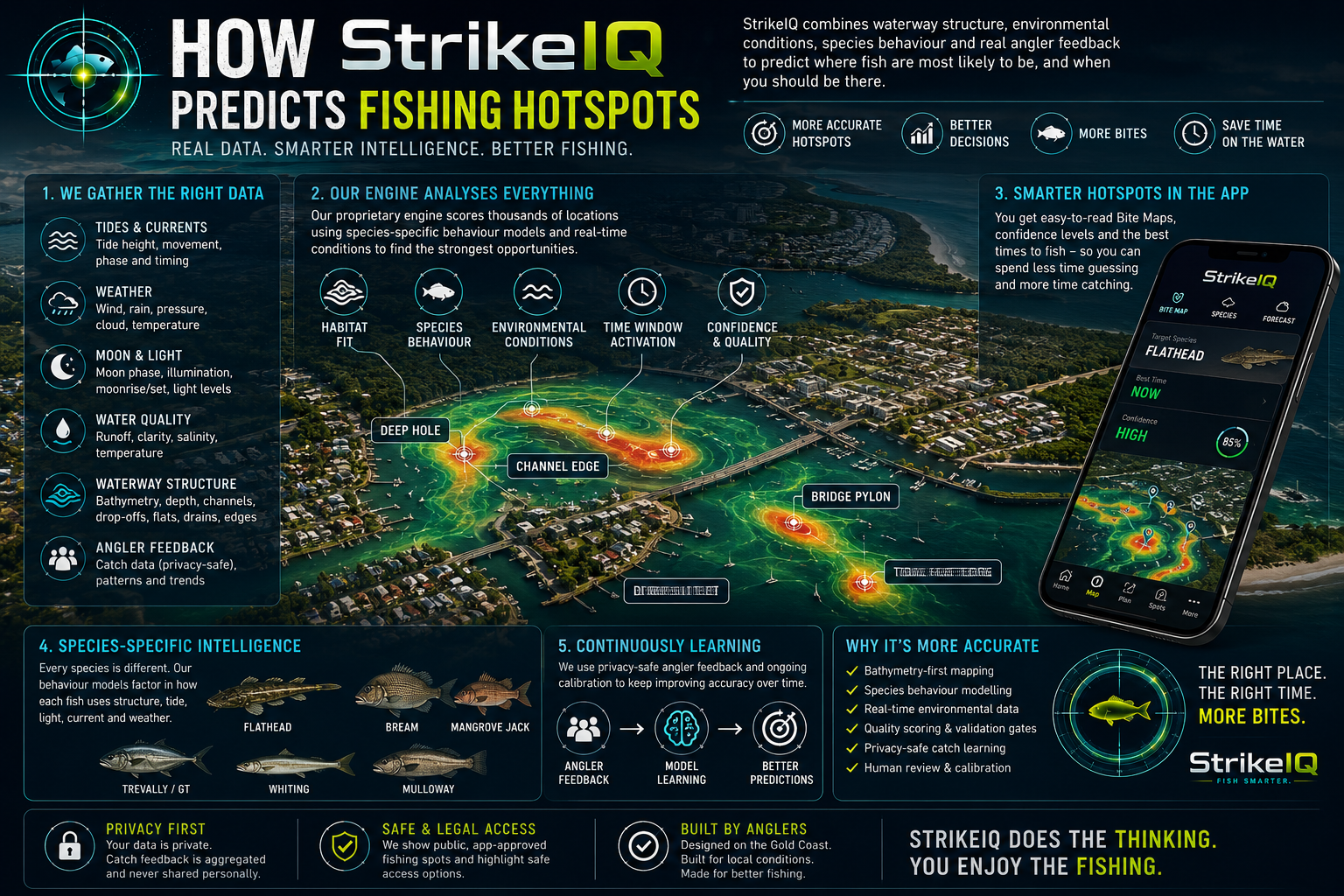
StrikeIQ is built to help anglers fish smarter by combining location intelligence, species behaviour, environmental conditions and local waterway patterns into one easy-to-use fishing forecast. Instead of guessing where to cast, anglers can use StrikeIQ to narrow down the most promising areas before they even hit the water.
The goal is simple; Spend less time searching and more time fishing productive water.
Fishing Hotspots Are Not Random
A productive fishing spot is rarely productive by accident.
Fish use their environment to feed, travel and shelter. They relate to structure, depth, tide movement, bait, shade, water clarity and changing conditions. A spot that fires one day may be quiet the next if the tide, weather or bait movement has changed.
That is why StrikeIQ does not treat every piece of water the same.
The app looks for areas where key fishing factors line up. These may include things like structure, current, depth changes, drains, flats, canal mouths, bridges, rock walls, pontoons, bait-holding edges and other features that anglers already know can hold fish.
But the real value is not just identifying the structure.
It is understanding when that structure is more likely to become active.
A drain may be average on one tide and excellent on another. A bridge may be quiet in bright slack water but come alive when current and low light line up. A flat may fish better when water is pushing across it, while a drop-off may become more important as bait drains away.
StrikeIQ helps connect those dots.
Species Matter
One of the biggest mistakes anglers make is treating all fish the same.
A flathead does not feed like a bream. A bream does not behave like a GT. A whiting does not use water the same way as a mangrove jack. A mulloway is not looking for the same conditions as a surface-feeding trevally.
StrikeIQ takes species into account so the Bite Map can highlight areas that make sense for the fish you are actually targeting.
For example, if you are chasing flathead, StrikeIQ may favour areas where ambush opportunities are stronger, such as drains, sand edges, drop-offs, channel lips and flat-to-deeper-water transitions.
If you are targeting bream, the app may put more focus on structure, shade, current edges, pontoons, rock walls, bridges, mangroves and areas where food is likely to be pushed past cover.
For trevally and GT, current, bait movement, canal mouths, bridges, deeper edges and active feeding lanes become more important.
For whiting, cleaner shallow flats, sand, gentle current and natural feeding zones matter more.
For mangrove jack, hard structure, shade, current and tight cover are key.
For mulloway, depth, tide movement, bait and low-light windows often play a bigger role.
This is why the best hotspot for one species may not be the best hotspot for another. StrikeIQ is designed to help anglers choose the right water for the right fish.
Conditions Change Everything
Most anglers check the tide before fishing. Good anglers also watch wind, rain, light, water clarity, bait and pressure.
StrikeIQ brings those factors together so anglers do not have to rely on one piece of information in isolation.
A tide chart by itself is useful, but it does not tell the whole story. A weather forecast helps, but it does not tell you which structure is likely to fire. Local knowledge matters, but conditions can change quickly.
StrikeIQ helps by considering how different conditions may influence fishing activity.
Tide movement is one of the biggest drivers. Moving water can push bait, activate drains, create current seams and make predators more willing to feed.
Light levels also matter. Dawn, dusk, night, cloud cover and shade can all change how confident fish feel when feeding.
Rain and runoff can help or hurt depending on the species and the amount of dirty water. Light or moderate runoff can push bait and create colour changes, while heavy dirty water may make some areas harder to fish.
Wind can push bait, create surface cover, dirty water, expose banks or shelter certain areas.
Moon and pressure can also influence bite windows, especially when they line up with tide, light and bait movement.
The important point is that StrikeIQ does not look at one factor alone.
It looks for the overlap.
A bridge with current, bait and low light is more interesting than a bridge in dead water. A drain with moving water after light rain is more interesting than a drain with no flow. A sand edge with the right tide movement is more useful than a random patch of shallow water.
That overlap is where better fishing decisions are made.
What the Bite Map Shows
The Bite Map is designed to make complex fishing information easy to understand.
Instead of forcing anglers to manually compare tide charts, weather data, moon phases, maps, structure and species habits, StrikeIQ turns those inputs into a visual fishing guide.
The app highlights areas that are more likely to be worth attention during the selected time window.
That does not mean every highlighted area will produce fish. Fishing will always involve skill, timing and adjustment on the water. But it does mean the angler is starting with a more informed plan.
The Bite Map helps answer practical questions like:
- Where should I start?
- Which species is worth targeting?
- Should I fish structure, flats, drains or deeper edges?
- Is this a better window for bottom fishing or active predators?
- Should I slow down, cover water, fish tight to structure or move to another zone?
That is what makes StrikeIQ useful. It does not just give you data. It helps turn data into a fishing plan.
Time Windows Matter
Fish activity changes throughout the day.
A spot that looks average in the morning may improve in the afternoon. A canal mouth may fish better as water begins to run. A bridge may become more productive after dark. A flathead edge may turn on when bait starts draining off shallow water.
That is why StrikeIQ uses time-based forecasting rather than treating the whole day as one static prediction.
When anglers choose a species and time window, StrikeIQ can show which areas are more likely to suit that situation.
This is especially useful for everyday anglers who only have limited time.
If you are fishing before work, after work, on a lunch break, at night or during a short weekend window, you do not want a generic “good day” or “bad day” forecast.
You want to know:
StrikeIQ is built around that question.
- Where should I fish during the time I actually have available?
Confidence Matters
Not every prediction should be treated equally.
Some areas have stronger evidence than others. Some conditions line up better than others. Some water is more suitable for one species than another. Some areas may look promising but lack the right access, timing or confidence.
StrikeIQ is designed to avoid over-promising.
The app aims to show useful, specific and relevant opportunities rather than colouring large areas of water and calling everything a hotspot.
That matters because too much information can be just as frustrating as too little.
A good fishing app should help narrow the search, not make the angler guess through more noise.
StrikeIQ focuses on giving anglers practical, confidence-based guidance that can be used on the water.
Local Waterway Intelligence
Fishing is local.
Canals, rivers, estuaries, flats, bridges, seaways and beaches all fish differently. Even nearby areas can behave differently depending on tide, depth, current, rainfall, bait and access.
StrikeIQ is designed to account for local waterway context rather than applying one generic formula everywhere.
That is especially important in canal and estuary systems, where fish can move between structure, drains, flats, bridges, pontoons, deeper holes and current lines throughout the day.
For example, a canal angler may use StrikeIQ to decide whether to start at a drain for flathead, a pontoon line for bream, a bridge light for trevally, or a deeper edge for mulloway.
The app helps reduce wasted time by pointing anglers toward the type of water that best suits the species and conditions.
Access and Practical Fishing
A fishing prediction is only useful if the angler can act on it.
StrikeIQ considers the practical side of fishing by helping connect hotspot information with nearby fishing access where appropriate.
That may include land-based access, boat-friendly areas, kayak opportunities or general fishing zones.
The aim is to help anglers understand not only where fish may be more active, but also how they might approach the area safely and responsibly.
A good-looking patch of water is not automatically a good place to fish from land. StrikeIQ helps separate fish-holding potential from practical access.
That makes the information more useful in the real world.
Learning and Improvement
StrikeIQ is built to improve over time.
Fishing conditions change. Seasonal behaviour changes. Anglers learn new things. Different waterways develop different patterns. Some species respond strongly to certain triggers, while others are more subtle.
StrikeIQ is designed so its fishing intelligence can be reviewed, calibrated and refined as more knowledge becomes available.
That improvement process is important. A fishing forecast should not be frozen in time. It should keep getting better as the system learns from conditions, patterns and responsible feedback.
At the same time, StrikeIQ is built with privacy in mind. Angler feedback can help improve the system without exposing private fishing locations or personal catch information.
The aim is to improve predictions while respecting the anglers who use the app.
How Anglers Can Use StrikeIQ
The best way to use StrikeIQ is as a decision-making tool before and during a session.
Start by checking the species forecast. See which fish are most likely to suit the current conditions.
Then check the Bite Map. Look at the areas being highlighted and think about what type of water they represent.
If the app is pointing toward drains and edges for flathead, fish close to the bottom with soft plastics, vibes or bait presentations that stay in the strike zone.
If it is showing current lines or bridge areas for trevally, fish more actively with paddle tails, jerk shads, small metals, vibes or surface lures depending on the conditions.
If it highlights structure for bream, slow down, cast tight, use lighter presentations and focus on shade, pontoons, rock walls and current edges.
If the window is fading, downsize, slow your retrieve and fish more carefully.
If the bite is building, cover water and look for bait.
StrikeIQ gives you the plan. Your job is to fish it properly.
Why It Helps
StrikeIQ helps because it reduces guesswork.
Instead of asking, “Where should I go?” with no starting point, anglers can begin with a short list of better options.
Instead of fishing every canal wall, every pontoon or every drain, they can focus on the areas where conditions and species behaviour are more likely to line up.
Instead of choosing a lure before choosing a plan, anglers can match their lure, retrieve and location to the opportunity in front of them.
That is the difference between fishing randomly and fishing with intent.
StrikeIQ does not replace experience. It supports it.
Experienced anglers can use the app to confirm patterns, compare options and plan sessions faster.
Newer anglers can use it to understand why certain areas are more likely to hold fish.
Either way, the outcome is the same:
Smarter decisions. Better use of time. More confidence on the water.
Final Cast
StrikeIQ is built around a simple idea:
Fish are not everywhere at once.
They respond to structure, tide, bait, weather, light, water movement and species-specific behaviour. When those factors line up, some areas become better than others.
StrikeIQ helps anglers find those areas faster.
It turns complex fishing conditions into practical guidance, so you can spend less time guessing and more time casting with purpose.
The Bite Map is not magic.
It is smart fishing intelligence designed to help you make better decisions.
Use it to narrow the search, choose the right species, fish the right zone and make every cast count.