
From Guesswork to a Game Plan: How StrikeIQ Live and Depth View Change the Way You Fish
Fishing rarely comes down to a single piece of information. The difference between a slow day and a productive one is often the quality of a series of small decisions: which stretch of water to try, where the bottom changes, how deep to work a lure, what colour and profile to choose, and when to change tactics.
Fishing rarely comes down to a single piece of information. The difference between a slow day and a productive one is often the quality of a series of small decisions: which stretch of water to try, where the bottom changes, how deep to work a lure, what colour and profile to choose, and when to change tactics.
StrikeIQ brings those decisions together in one connected experience. Bite Map helps identify the most promising opportunities. Depth View reveals the underwater shape in both 2D and 3D. Lure Match turns the current conditions into a practical tackle and presentation plan. StrikeIQ LIVE then keeps that plan available on the water, while recording what actually happened so the next trip can be more informed.
The result is not a promise of guaranteed catches or a replacement for an angler’s judgement. It is a more disciplined way to turn environmental information into action.
Start with better water, not more casts
Bite Map is designed to answer the first question every angler faces: where should I spend my time?
Instead of treating an entire region as equally productive, it ranks available opportunities using the selected species, location, timing and supporting environmental evidence. An angler can open Why Here to understand the reasoning, compare two spots, inspect the best windows and move directly into the selected opportunity without losing its identity.
That matters because a promising point on a map is only useful if the angler can understand how to fish it. Bite Map connects the location to the next decisions: depth, structure, timing, technique and tackle. It also keeps the chosen species, spot and forecast window intact as the angler moves between screens.
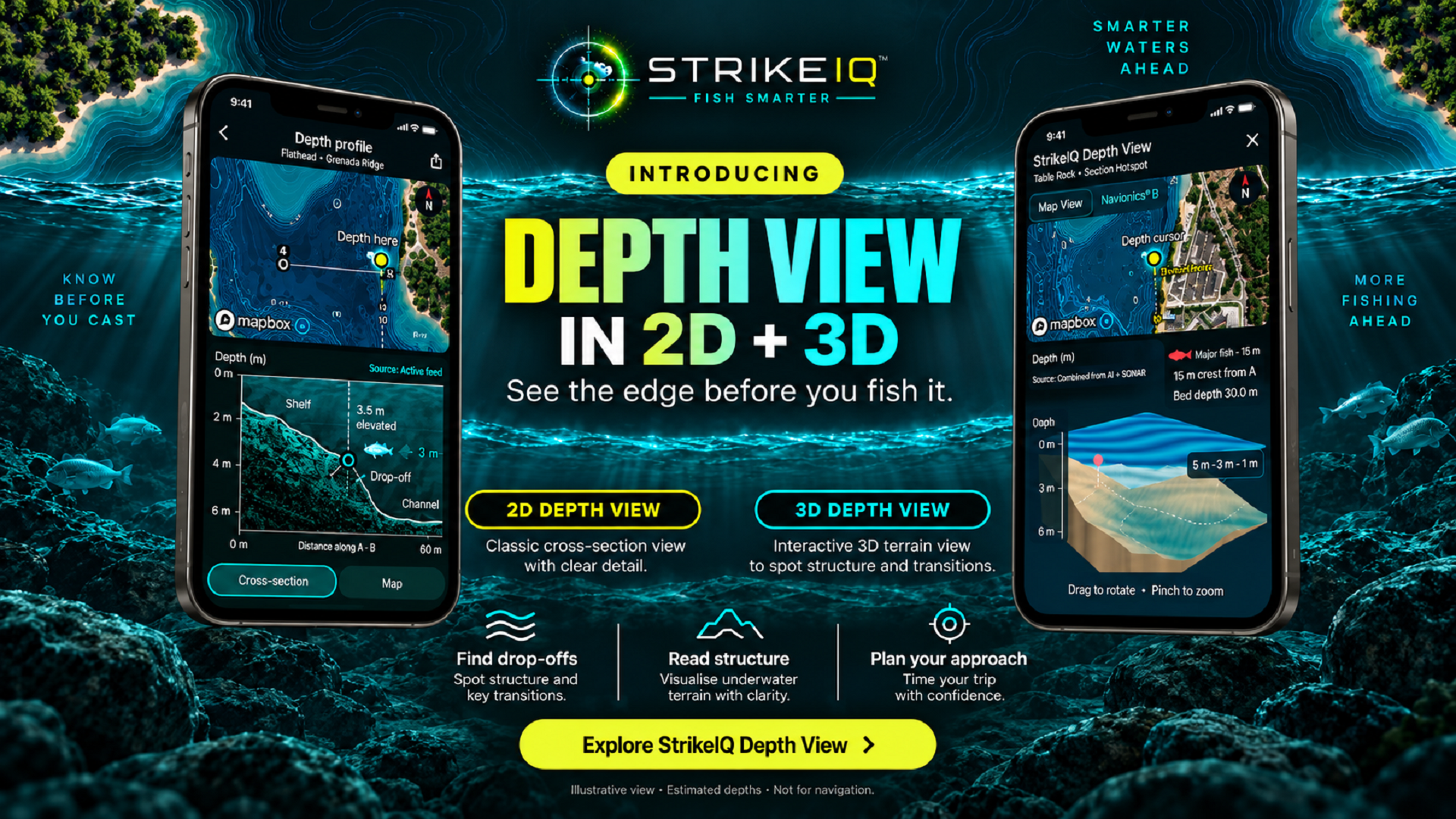
Depth View in 2D: read the bottom before you work it
The 2D Cross-section is a simple but powerful way to understand underwater terrain. The angler selects or adjusts an A–B transect across a chosen area and sees the bottom profile as a true depth plot rather than a flat colour surface.
That cross-section can reveal:
- shelves where a flat area meets a deeper edge;
- drop-offs and channels that concentrate moving water;
- gradual slopes that call for a controlled retrieve;
- depth changes across a cast, drift or trolling line; and
- the relationship between the bottom and a supported target-depth range.
This changes how an angler approaches a spot. Instead of casting at a pin and hoping the lure is in the right zone, they can decide which side of an edge to work, how much weight is appropriate, whether to keep the lure above the bottom or let it contact the contour, and where to reposition when the first presentation is not producing.
Depth View also makes depth control more deliberate. A lure that is retrieved at one metre is fishing a completely different part of the water column from one worked near a four-metre channel. Seeing that change on a profile helps anglers match their retrieve, sink time, leader length, jighead or sinker choice to the terrain in front of them.
Depth View in 3D: understand the shape of the whole area
The 3D Bottom View adds the perspective that a single profile cannot provide. The angler can rotate, zoom and inspect the underwater surface to see how shelves, cuts, ridges and basins connect around the selected opportunity.
That broader view is useful when planning a drift or working a piece of structure from multiple angles. It can show whether a visible break continues along the edge, whether a channel opens into a larger basin, or whether two apparently separate features are part of one connected contour.
The 2D and 3D views work together:
2D Cross-section - Precise depth changes along a chosen line, target-depth checks and retrieve planning. 3D Bottom View -Understanding the surrounding terrain, connected structure and possible approach angles.
Both views are built from available bathymetric and terrain sources. They are not sonar, do not detect individual fish and do not turn a mapped contour into a live observation. Where coverage or datum support is limited, StrikeIQ should show the gap rather than invent a smooth seabed or a false level of precision.
StrikeIQ LIVE: a copilot for the moments that matter
Once the angler starts fishing, the challenge changes. Conditions move, attention is divided and the best plan may need to be adjusted quickly. StrikeIQ LIVE is built for that part of the trip.
LIVE keeps the selected region, species, opportunity and setup in context while the angler fishes. With hold-to-talk voice interaction and quick actions, an angler can record a Catch, Strike, Follow or Nothing without stopping to navigate through a series of forms. The screen can provide the next best move, bring the map back into focus, guide the angler to a selected feature and preserve the exact setup that was chosen before launch.
That creates a useful feedback loop on the water:
- Select the opportunity and understand the structure.
- Choose a lure, bait and presentation that fit the conditions.
- Fish the area with the depth and approach in mind.
- Log what happened immediately, including a catch, a strike, a follow or no action.
- Adjust the next move without losing the original target or forecast window.
LIVE is meant to reduce friction, not add another dashboard to manage. The angler stays focused on the water while the important decisions and observations remain connected.
Fine-tune lures, bait and gear for the situation
The most practical benefit of connected mapping is that it can improve the quality of the tackle decision. Lure Match considers the selected species and location alongside conditions such as tide, wind, weather, depth, light, water clarity, structure and the chosen fishing window.
Rather than offering a generic “best lure,” it can help narrow the choices to a more appropriate setup:
- lure family and profile;
- size, colour and visibility for the conditions;
- retrieve or presentation style;
- jighead, weight or sinker choice for the depth;
- hook, leader and terminal-tackle considerations; and
- bait or alternative presentation when an artificial lure is not the best fit.
For example, an angler working a shallow-to-deep edge may need a presentation that reaches the contour without constantly snagging. An angler on a bright, clear day may need a different profile or colour emphasis than one fishing a turbid, overcast window. StrikeIQ does not remove the need to experiment; it gives the experiment a clearer starting point and makes the reason for a change easier to understand.
The trip keeps teaching you
StrikeIQ’s Analytics layer turns individual sessions into a longer-term learning system. Catches, strikes, follows, no-action sessions, lures, locations, times and conditions can be reviewed together to identify personal patterns.
That may reveal that a particular technique performs better on a certain type of edge, that a species is more reliable during a specific daypart, or that a favourite lure is being fished outside its most effective depth. It also preserves the value of an unsuccessful session. “Nothing” is still useful evidence when it is attached to the real place, time, weather, setup and presentation.
The goal is not to fabricate certainty from thin data. When evidence is limited, the experience should say so. As more genuine trips are recorded, the angler can refine their own approach with a record that is more useful than memory alone.
What this means for the angler
Together, these features help anglers:
- spend more time on defensible opportunities and less time making blind casts;
- see how the bottom changes before committing to a drift or retrieve;
- keep a lure in the intended part of the water column;
- adapt colour, profile, bait and terminal tackle to actual conditions;
- make faster changes when the first presentation is not working;
- log useful observations while attention stays on fishing; and
- build a personal record of what works, where and when.
The advantage is consistency. A good day no longer has to depend on remembering every detail or repeating the same setup out of habit. The angler can make a reasoned plan, test it, observe the result and improve the next decision.
A practical StrikeIQ workflow
For a complete trip, the workflow is straightforward:
- Choose a region and target species.
- Select a future or current fishing window.
- Review the ranked Bite Map opportunities and open Why Here.
- Use 2D Cross-section to inspect the depth line, then 3D Bottom View to understand the surrounding structure.
- Open Lure Match and select a lure, bait and gear setup suited to the depth and conditions.
- Tap Fish It to move into StrikeIQ LIVE.
- Use LIVE for guidance and quick action logging while fishing.
- Review the session in Analytics and carry the evidence into the next trip.
StrikeIQ is built to help anglers fish with more context, more control and less guesswork—from the first map decision to the final log entry.